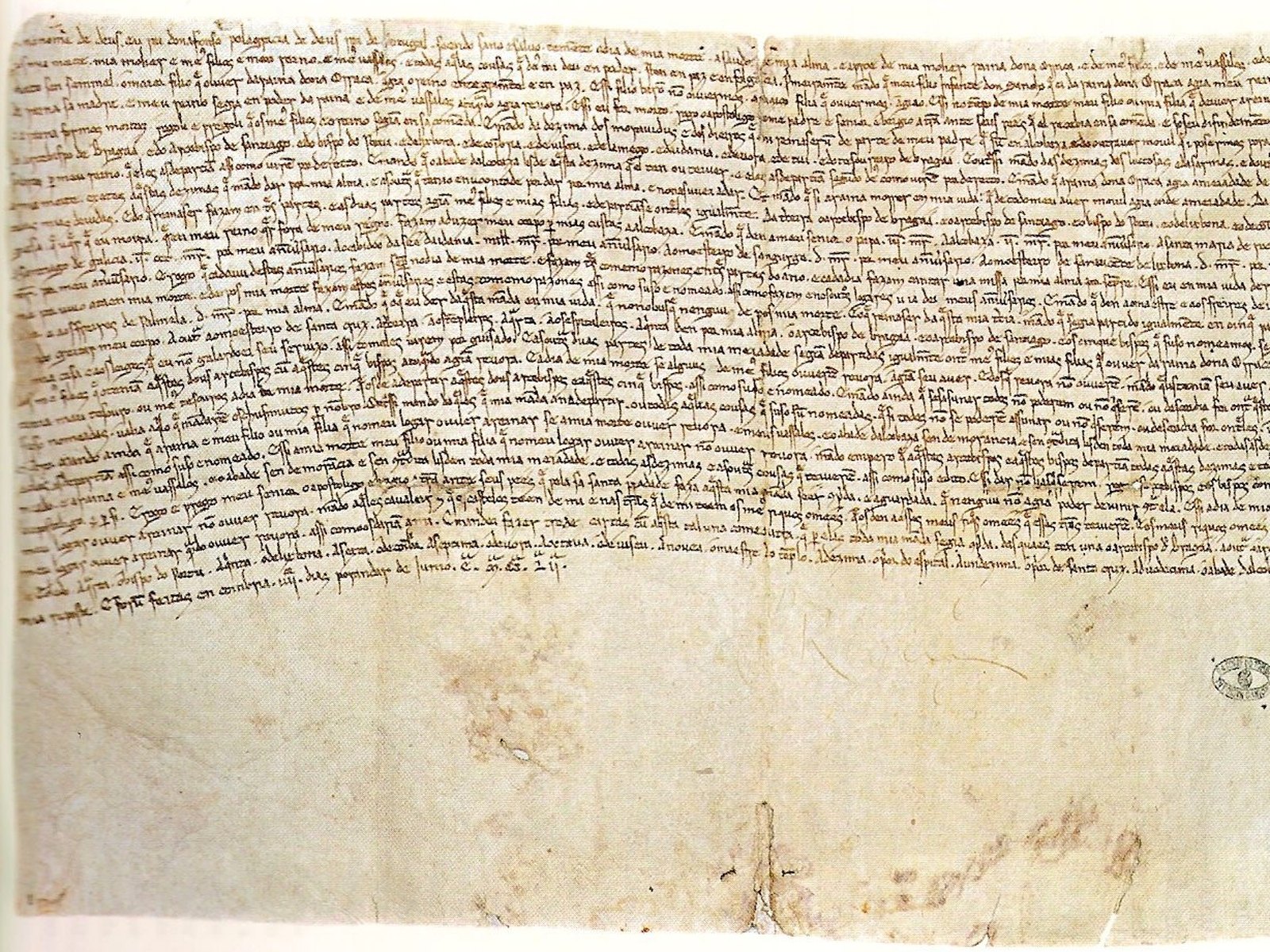
Coimbra, June 1214. A king of twenty-eight or twenty-nine has someone write down what should happen when he dies. He isn’t ill — he says so himself in the first line. And he doesn’t write it in Latin, the language of everything that mattered. He writes it in the language people spoke.
It is the oldest document by a king in Portuguese that has come down to us. But before we read it, we need to know who this king was, and why a young, healthy man was thinking about death.
First, the map
In the last episode, in 1147, Afonso Henriques — the first king — took Lisbon with the crusaders’ help. He died in 1185. His son, Sancho I, succeeded him.
Portugal now ran from the river Minho to beyond the Tagus — the will itself mentions the bishop of Évora and the knights of Palmela. Coimbra, Santarém and Lisbon were the big cities. Further south, starting at Alcácer do Sal, the land was still Muslim. And all around were bigger neighbours: the kingdom of León, to the north and east, and Castile.
In March 1211 Sancho I died, aged 57, after a long illness. He left the throne to his eldest son, Afonso. This is Afonso II.
Who Afonso II was
Grandson of Afonso Henriques, son of Sancho I. As a child, writes the historian Alexandre Herculano, his health was so poor that his father doubted he would outlive him. As a teenager he fell so violently ill that his recovery was put down to a miracle.
He became known as “the Fat”. Now, honesty: Herculano writes that the obesity is something “tradition attributed” to the king, and that he doesn’t know on what grounds.
He married Urraca, daughter of the king of Castile. By 1214 they had small children, and the eldest, Sancho, was the heir.
A war over a will
And here’s the point: when Afonso II made his will, he was at war over his father’s.
Sancho I left the kingdom to his son. But he left his daughters important lands and castles:
- to Teresa (not to be confused with Queen Teresa of episode 1.1, his great-grandmother), Montemor-o-Velho and Esgueira;
- to Sancha, Alenquer;
- to Mafalda, the monasteries of Arouca and Bouças and lands at Seia.
After Coimbra, Santarém and Lisbon, Montemor and Alenquer were perhaps the most important places between the Mondego and the Tagus.
Afonso II said no. To him, the king’s lands couldn’t be split: they passed whole to whoever reigned. He demanded the castles from his sisters three times, eight days apart. They used the time to fortify Montemor and Alenquer, and Teresa, Sancha and another sister, Branca, shut themselves up in the castle at Montemor.
The king even offered a compromise: the castle would be held by a noble both sides trusted, and all its income would go to Teresa. They refused. The princesses’ supporters called in the king of León, Alfonso IX. And he was no stranger: he had been married to Teresa, and he brought their son with him. He invaded Portugal, took castles in the north and burned much of Trás-os-Montes. Afonso II’s troops lost a battle at Valdevez, in the Minho.
It took the Pope to swap the swords for lawyers. Herculano sums it up: a fight inside the family “that had lasted five years”. And Mafalda, at least, lost Bouças, which her father had left her.
The 1214 will was written in the middle of all this. It’s tempting to read a lesson into it: the father left a will that split the kingdom; the son’s very first order is that his heir shall have the kingdom “entegramente e en paz” — whole and in peace. That’s my reading; it isn’t written anywhere. But the word is there.
What the will says
It begins:
“En’o nome de Deus. Eu rei don Afonso pela gracia de Deus rei de Portugal, seendo sano e saluo, temẽte o dia de mia morte…”
In English: “In the name of God. I, King Afonso, by the grace of God king of Portugal, being safe and sound, fearing the day of my death…”
Then, point by point:
- Who inherits: his son Sancho, by Queen Urraca. If Sancho dies childless, the next son inherits. And if there is no son, the eldest daughter inherits. In 1214, a daughter could be left the kingdom.
- If the heir is a child: he stays with his mother, and the kingdom is in the hands of the queen and the vassals until he comes of age.
- The protector: the king asks the Pope, “as father and lord”, and — his words — “I kiss the ground before his feet”, to take the queen, the children and the kingdom into his care.
- The queen: gets half of the king’s movable goods — money, gold, objects; not land — apart from what was already set aside for his soul.
- The other half: debts are paid first. Of what’s left, two thirds go to his sons and daughters “igualmente” — equally, boys and girls alike. The last third is for his soul.
- His body: wherever he dies, inside the kingdom or out, it is to be taken to Alcobaça at his expense.
- Masses: the money comes out of that last third, in morabitinos, gold coins. Three thousand go to the Pope, as a gift. And, for prayers for his soul every year on the day he died: two thousand to Alcobaça, two thousand to Our Lady of Rocamadour, in France, two thousand three hundred to Santiago de Compostela, and more to Idanha, São Vicente in Lisbon and the canons of Tui. And he asks for one mass a day “forever”.
- Who carries out the will: the archbishops of Braga and Santiago and five bishops. If they disagree, the majority decides.
He also asks that, if he pays for these masses while still alive, they pray for him “come por uiuo” — as you pray for a living man — for as long as he lives, and only hold the anniversary masses after his death. He paid in advance, but didn’t want to miss out.
Thirteen copies
To make sure it was all carried out — that’s what the text itself says — the king had thirteen identical letters made. The text also says where each one went:
- the archbishop of Braga
- the archbishop of Santiago
- the archbishop of Toledo
- the bishop of Porto
- the bishop of Lisbon
- the bishop of Coimbra
- the bishop of Évora
- the bishop of Viseu
- the master of the Templars
- the prior of the Hospitallers
- the prior of Santa Cruz in Coimbra
- the abbot of Alcobaça
- and the last, kept in the king’s own treasury.
It ends with the place and date: “made in Coimbra, four days to go in June, Era 1252”. Four days to go in June is 27 June. And the Era of 1252 is the “Hispanic Era”, the dating system of the time, which ran 38 years ahead of ours: 1252 minus 38 is 1214.
Of the thirteen, two survive: the one sent to Braga, now in the Torre do Tombo national archive in Lisbon, and the one in the cathedral archive in Toledo.
But is it really the first?
It’s often said that this is “the first text ever written in Portuguese”. The truth is, not quite.
There are older texts that specialists argue about:
- The Notícia de Fiadores (1175): a list of eleven names with sums of money. It’s dated, but it’s so short and so full of Latin that some say it doesn’t count.
- The pact between Gomes Pais and Ramiro Pais (before 1175): a deal between two brothers. Gomes promises his steward won’t squeeze his brother’s lands and people; in return, Ramiro will help him “against anyone, except the king and his sons”. It has no date; we know it’s older because the parchment was reused on the other side for a sale in April 1175.
- The Notícia de Torto (around 1214): the complaint of one Lourenço Fernandes da Cunha against the sons of one Gonçalo Ramires, who wronged him — among other things, for three years they took the harvest of a farm “cun torto”, wrongfully.
What can be said safely is this: the 1214 will is the oldest document by a king written in Portuguese that has come down to us. The language itself was the same on both banks of the river Minho: linguists call it Galician-Portuguese.
And there’s an irony. Father Avelino de Jesus da Costa, who studied these documents, noted that the will seemed to stand alone: in his day, the next known document in Portuguese was from 1255 (that date later turned out to be wrong, and others have since been found). And when Afonso II himself made a second will, in November 1221, he went back to Latin. Latin only stopped being the language of the king’s official documents in the reign of King Dinis, between 1279 and 1325.
What happened next
The king in perfect health lived almost nine more years, and got little rest: first his sisters, then the nobles and the Church.
He wanted to know who owned what: he made lords and monasteries produce the deeds to their lands and privileges, and in 1220 he sent inquirers through the north to ask who held what. It didn’t win him friends.
Nor was he one to go to war in person. In 1212 he sent troops to the great battle of Las Navas de Tolosa, but didn’t go himself. In 1217, when crusaders and Portuguese besieged and took Alcácer do Sal, he was travelling between Alcobaça, Coimbra and Guimarães. Herculano asks the question any reader would: “But Afonso II, where was he?”
He fell out with the archbishop of Braga and had the archbishop’s property destroyed; the archbishop excommunicated him. Afonso II died on 25 March 1223, aged 37, still excommunicated. The archbishop refused him a Christian burial until the new king’s guardians paid up.
The new king was his son Sancho — the same Sancho of the will, now Sancho II. According to Herculano, he was only about thirteen. Exactly the case his father had planned for: an heir too young to reign.