Sit down, this one has no battle in it. Which is exactly why it’s one of the most important.
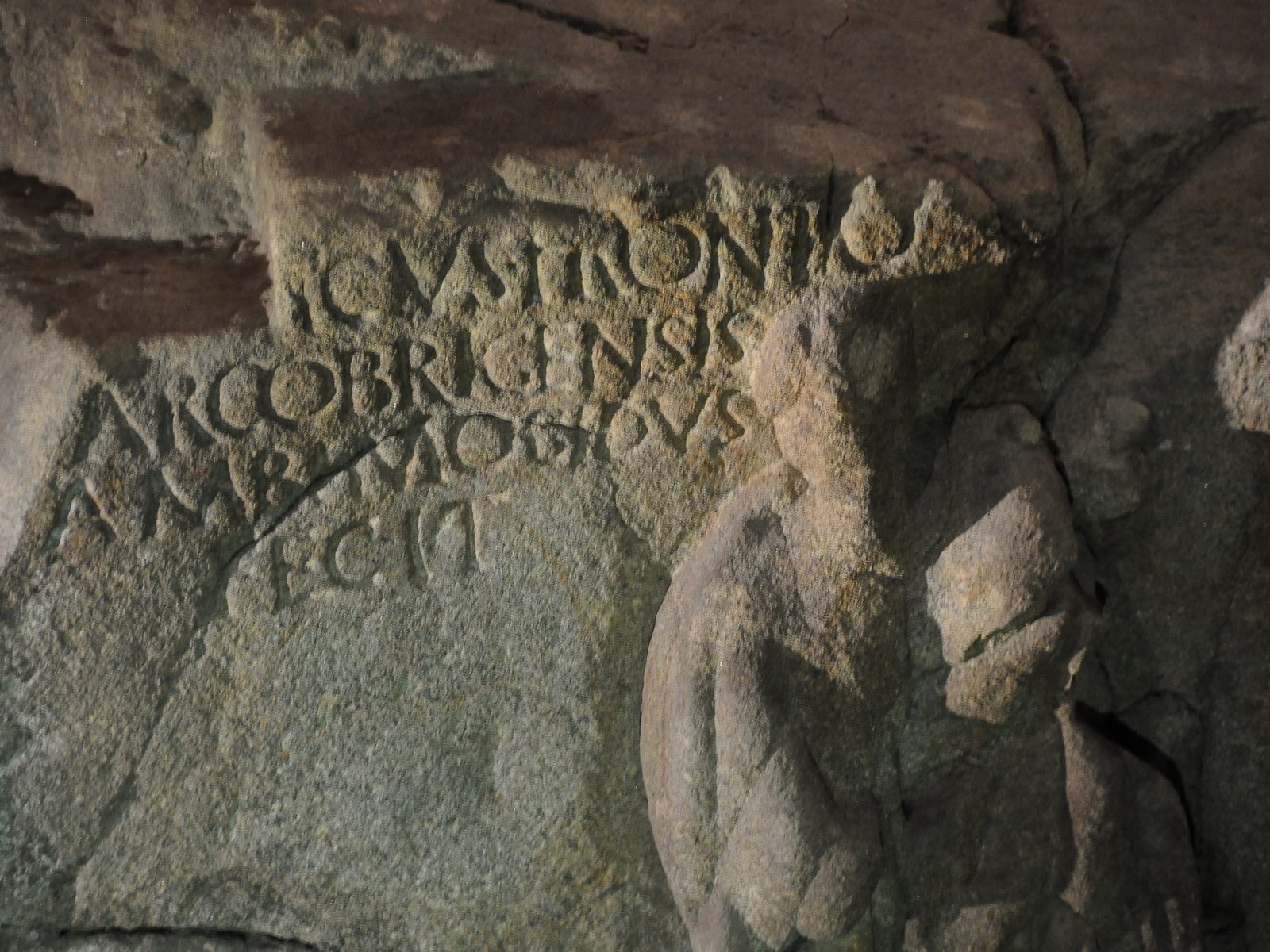
There’s a rock in Braga, on a narrow street near the centre, with water still coming out of it. Two thousand years ago someone had a figure carved into it, a little temple with a bird on the roof, and a few letters. The letters say, more or less, that it was Celicus Fronto, a native of Arcobriga, who had it made.
Arcobriga was another place, far from Braga. That’s why the archaeologists of the University of Minho call Celicus an immigrant. A man from elsewhere who came to Braga and did what outsiders tend to do to belong — he adopted the local gods. The inscription dedicates the shrine to Tongoenabiagus, a god whose name no Roman could have pronounced first time; many scholars think the figure beside it is Nabia, a goddess of waters. Gods who had been there long before any legion.
But the dedication is in Latin.
An outsider, praying to the gods of this place, in the language of Rome. That’s this whole episode, in a single stone. And his family didn’t forget: Celicus’s grandsons and great-grandsons later came back to the spring to restore it.
The city that fell from the sky
Remember the Bracari, from the last episode? The women who fought without a sound, beyond the river Lima. A hundred-odd years later, around 16 or 15 BC, in the time of the emperor Augustus, a new city was born in the middle of that hill-fort country. There was no hill-fort on that spot — it was the place where the hill-fort people met, with a small bath-house for ritual bathing. Archaeologists think the city came out of an agreement between Rome and the leading local families. They built it from scratch, with straight streets laid out on a grid, as if it had dropped from the sky ready-made.
It got the name of the defeated and the name of the emperor: Bracara Augusta.
The idea was simple. Instead of forcing people down from the hill-forts, offer them something better down below: a market, roads, piped water. A century later the city already had baths at the top of the Cividade hill and, next to them, a theatre — which archaeologists from the University of Minho found in 1999. It’s the first known theatre in any city of the north-west of the Peninsula.
Nobody had to ban anything. Life just had to be easier in Latin.
The Happy one
Further south, at the mouth of the Tagus, there was a much older port. Under the Baixa, Lisbon’s downtown, archaeologists found a riverside district, from the 5th and 4th centuries BC, that grew with trade from the eastern Mediterranean. The Romans called it Olisipo.
Pliny the Elder, a Roman who wrote an encyclopaedia in the 1st century, catalogued the whole of Lusitania — forty-five peoples. He counts five colonies, towns founded by Rome, and just one municipium of Roman citizens: an existing town whose people were given the same rights as someone born in Italy. That one municipium was Olisipo. Its full name is the best name Lisbon has ever had: Felicitas Iulia Olisipo. The Happy one.
The same Pliny swears Olisipo was famous for something else: its mares got pregnant from the west wind. Ancient legend, obviously. But it’s on record.
Happy, and smelling of fish. On Rua dos Correeiros, beneath a bank, there are 31 salting tanks, grouped into seven small factories that worked from the 1st century to the middle of the 5th. Before it was a factory, that ground had been a cemetery for the first Roman settlers — eight graves holding nine people, five of them children. Lusitanian salted fish and fish sauces reached Rome in amphorae. Lisbon was exporting preserved fish two thousand years before the sardine can.
The slave who paid for the stage
And Lisbon had a theatre, cut into the castle hillside, under what is now Rua de São Mamede. In AD 57 someone paid to have its stage and orchestra renovated, and had a dedication to the emperor of the day carved. It ran across five niches along the front of the stage, so it could be read from the seats.
The emperor was Nero.
The man who paid was called Gaius Heius Primus, and he had a title that says it all: augustalis perpetuus. The Augustales were nearly always freedmen — former slaves who had won their freedom and made a fortune, but were barred from political office because of their origins. So they did what the newly rich do in every age: they paid for buildings with their names in full view.
We know he had been a slave himself because of another stone from the theatre. It was put up in his honour by his own freedmen — and it calls him “freedman of Gaius”. The former slave had owned slaves, freed them, and they thanked him on a stone. In Latin, naturally.
The ruins turned up while the city was being rebuilt after the 1755 earthquake; in 1798 an architect drew them, and they were buried again.
Nobody decided anything
Nobody decided the peoples here were going to start speaking Latin. There was no law, no compulsory school, no set date.
Latin probably arrived the way any language in charge arrives: through soldiers who stayed and married local girls, through traders who did their sums in Latin, through judges, tax collectors and shop signs. If you wanted to sell, get ahead or win a lawsuit, you spoke Latin. It probably went something like this: the children spoke it better than their parents, and the grandchildren no longer knew their grandparents’ language.
And it wasn’t the Latin of polished prose. It was spoken Latin, the Latin of the street.
Educated Latin said equus for horse. In ordinary mouths it was caballus, the word for a workhorse, a nag. Guess which one stuck. That’s why the Portuguese say cavalo, the French cheval and the Italians cavallo. Eating went the same way: the bookish verb was edere, but people said comedere, to eat it all up — and no Romance language kept the bookish verb. Even the emperor Augustus, in a letter, wrote that he had eaten “two bucceae” — two mouthfuls, from bucca, a puffed-out cheek. That’s where the Portuguese word for mouth, boca, comes from.
Now, honesty: very little survives of the languages spoken here before Rome. Of Lusitanian, in the south, we have only about six proper inscriptions. It was Indo-European; whether it was Celtic or not, specialists are still arguing. Of Gallaecian, in the north, what’s left are the names of gods like the one on the Braga fountain, and the names of places and rivers. Almost all of it was lost — not through massacre, but through disuse.
What was left
Six centuries of Rome, and what survived wasn’t the legions. It was the roads, the bridges, the name of Braga, the word cavalo and a rock with water running out of it.
And the habit of praying to the gods from here in a language from over there. That, in a way, never left us.