This is one of the confusing ones — two brothers, a pope, a queen, a war and a legend. So before we start, let’s meet the cast.
Who’s who
- Sancho II — the king. He’s the little boy from the last episode: the heir in the 1214 will, who became king at about thirteen.
- The Count of Boulogne — the king’s younger brother. His name is also Afonso, but so we don’t mix him up with his father (Afonso II), we’ll always call him the count. He lived in France. He will later be King Afonso III.
- Mécia Lopes de Haro — Sancho II’s wife, a noblewoman from Castile.
- Pope Innocent IV — head of the Church, who is about to take the government away from a king.
- The Portuguese bishops — above all the archbishop of Braga and the bishop of Coimbra, the king’s greatest enemies.
- Martim de Freitas — the castellan (the commander) of Coimbra castle. He’s the hero of the legend at the end.
And here’s the whole story as a timeline, to check whenever you get lost:
- 1223 — Sancho II becomes king, aged about 13.
- 1226–1239 — he conquers towns in the Alentejo and the Algarve.
- c. 1241–1243 — he marries Mécia.
- February 1245 — the Pope orders an inquiry into the marriage.
- 24 July 1245 — the Pope hands the government of the kingdom to the count.
- 6 September 1245 — in Paris, the count swears to the bishops what he will do.
- End of 1245 — the count lands in Lisbon. The brothers’ war begins.
- 1246 — Queen Mécia vanishes from Coimbra one night.
- 1247 — Sancho gives up and goes to live in Toledo, in Castile.
- January 1248 — Sancho dies in Toledo. The count becomes king: Afonso III.
Now, the story.
First, the map
In the last episode, in 1214, King Afonso II made his will and planned for the worst: “if my heir is a child…”. That’s exactly what happened. Afonso II died in 1223, excommunicated, and his son, Sancho II, became king at about thirteen.
The kingdom ran from the Minho to beyond the Tagus. To the south — the lower Alentejo and the Algarve — the land was still Muslim. At first, the people actually governing were his father’s men: Herculano calls them “more guardians than ministers”.
The boy king who conquered half the Alentejo
The first thing to know about Sancho II is that he didn’t sit still.
- In 1226, at about sixteen, he went with the army to Elvas. His life was in danger, and a knight, Afonso Mendes Sarracines, saved him. Elvas didn’t fall then, but a few years later the Muslims abandoned it, and Juromenha with it.
- Around 1232, Moura and Serpa opened their gates to the Christians.
- In 1234, Aljustrel.
- Before 1239, Mértola, and soon after Tavira and Cacela, already in the Algarve.
Almost all of it with the help of the military orders — knights who were also monks, living for the war against the Muslims — above all the Order of Santiago, to which the king gave the conquered lands. Whenever Sancho II is called a weak king, it’s worth remembering this.
So what went wrong?
On the frontier, the king was winning. At home, almost everything was going wrong:
- The nobles were fighting family wars with each other, and complaints of violence were reaching Rome.
- The bishops complained the king wasn’t protecting them or the Church’s property.
- The king’s enemies spread the word that he was “mentecapto” — feeble-minded.
And then there was the marriage. Around 1241–1243, Sancho married Mécia Lopes de Haro, a Castilian noblewoman, a widow, and daughter of the lord of Biscay. They were related in the fourth degree — too close under the Church’s rules of the time, unless the Pope gave special permission. They didn’t have it.
In February 1245, the Pope ordered an inquiry into the marriage. And the Pope’s letter says who asked for it: the Count of Boulogne — the king’s brother.
The brother who lived in France
So who was the count? The king’s younger brother, son of the same father. He lived in France: in 1238 he married Mathilde, Countess of Boulogne — a territory in northern France — and that’s what gave him the title of count. In 1242 he fought alongside the king of France.
He had no kingdom of his own. And his brother’s was right there, full of complaints.
Why could a pope give orders to a king?
It seems odd today. But in 1245 the Pope had a great deal of power over Christian kings — and with Portugal he had a special link. Ever since Afonso Henriques, the kings of Portugal had promised the Pope a yearly tribute of two marks of gold (they didn’t always pay it), and in return the Pope recognised and protected the kingdom. In the last episode, Afonso II even placed his queen, his children and his kingdom “in the care” of the Pope in his will.
The Portuguese bishops had been complaining to Rome for some time. In March 1245, the Pope told the bishops of Porto and Coimbra to bring the king to his senses. A few months later, he went further.
The bull: “we take nothing from him”
A bull is an official letter from the Pope, with the force of law.
In July 1245, Pope Innocent IV was in Lyon (today in France) for a council, a great meeting of the Church. On 24 July, a week after the council ended, he signed the bull Grandi non immerito. What it says:
- that Sancho had taken up the government of the kingdom “from his childhood” — that is, he took the kingdom on as a child;
- that the count is to have “the general and free care and administration” of the kingdom, and the defence of the churches — he becomes the “curator”, the one who looks after it;
- that the Portuguese must receive him in their cities, castles and towns, whatever oath they had sworn to the king;
- but that they must protect the king’s person and life;
- and, at the end: “by this we do not intend to take the kingdom from the said king, nor from his legitimate son, if he has one”.
So: Sancho was still king, in name. But the one in charge was now his brother. Herculano sums it up drily: Sancho was left “an empty title” — and the hope of a son, which the plotters, he writes, were determined to prevent.
The oath of Paris
With the bull in hand, the archbishop of Braga and the bishop of Coimbra went to Paris to see the count. On 6 September 1245, in the house of the chancellor of the University, the count swore to them what he would do when he reached Portugal. He promised:
- to keep the good laws and customs of his grandfathers’ time;
- to appoint honest judges;
- to punish anyone who harmed the clergy;
- to return property taken from the churches;
- to obey Rome and listen to the bishops.
Herculano called it “almost an abdication of royal authority at the feet of the bishops”. Put simply: the count wasn’t in charge of anything yet and had already promised the bishops almost everything they wanted — keeping only the castles and the money for himself.
The brothers’ war
The count reached Lisbon by sea at the end of 1245 (Mattoso says December; Herculano thought it might already have been 1246). Lisbon took his side. A civil war began — Portuguese against Portuguese — that lasted more than a year.
- Castles taken by force: Guimarães and the castle of Faria, among others.
- Castles bought: tradition says so of Leiria and Lanhoso (see “On the ground”, below).
- On Sancho’s side: the master of the Templars and the bishop of Viseu, among others.
- Help from Castile: the heir to the throne of Castile — the future King Alfonso X — rode into Portugal to help Sancho. It made no lasting difference.
The night the queen vanished
In 1246 came the hardest blow. According to the Book of Lineages — a book about the noble families, attributed to Count Pedro — Raimundo Viegas de Portocarreiro, brother of the archbishop of Braga, slipped at night into Coimbra, where the king was sleeping, took Queen Mécia and carried her off to Ourém. When Sancho went after her, he was met at Ourém with arrows and stones.
Now, honesty: historians don’t really know what that was. Herculano noticed that in September 1246 Mécia turns up in Ourém making grants freely, surrounded by her own relatives, and suspected it “was more flight than abduction”. José Mattoso, a modern historian, tells it as an abduction. Nobody has the answer.
Exile and death
Without his wife, his cities or his bishops, Sancho went to ask Castile for help. When that help failed too, he gave up: in 1247 he went to live in Toledo, in Castile. He died there in January 1248, aged about thirty-eight — roughly the age at which his father had died.
He had asked to be buried at Alcobaça, like his father. The Pope even ordered it. It didn’t happen: he stayed in Toledo, in the cathedral. In 1289 a king of Castile moved his tomb to another chapel. I confess I haven’t been able to confirm where it is today.
With his brother dead, the count stopped being “curator” and became king: Afonso III. He’s the one we’ll meet in the next episode.
The legend of the keys
And now, the legend — the one everyone knows.
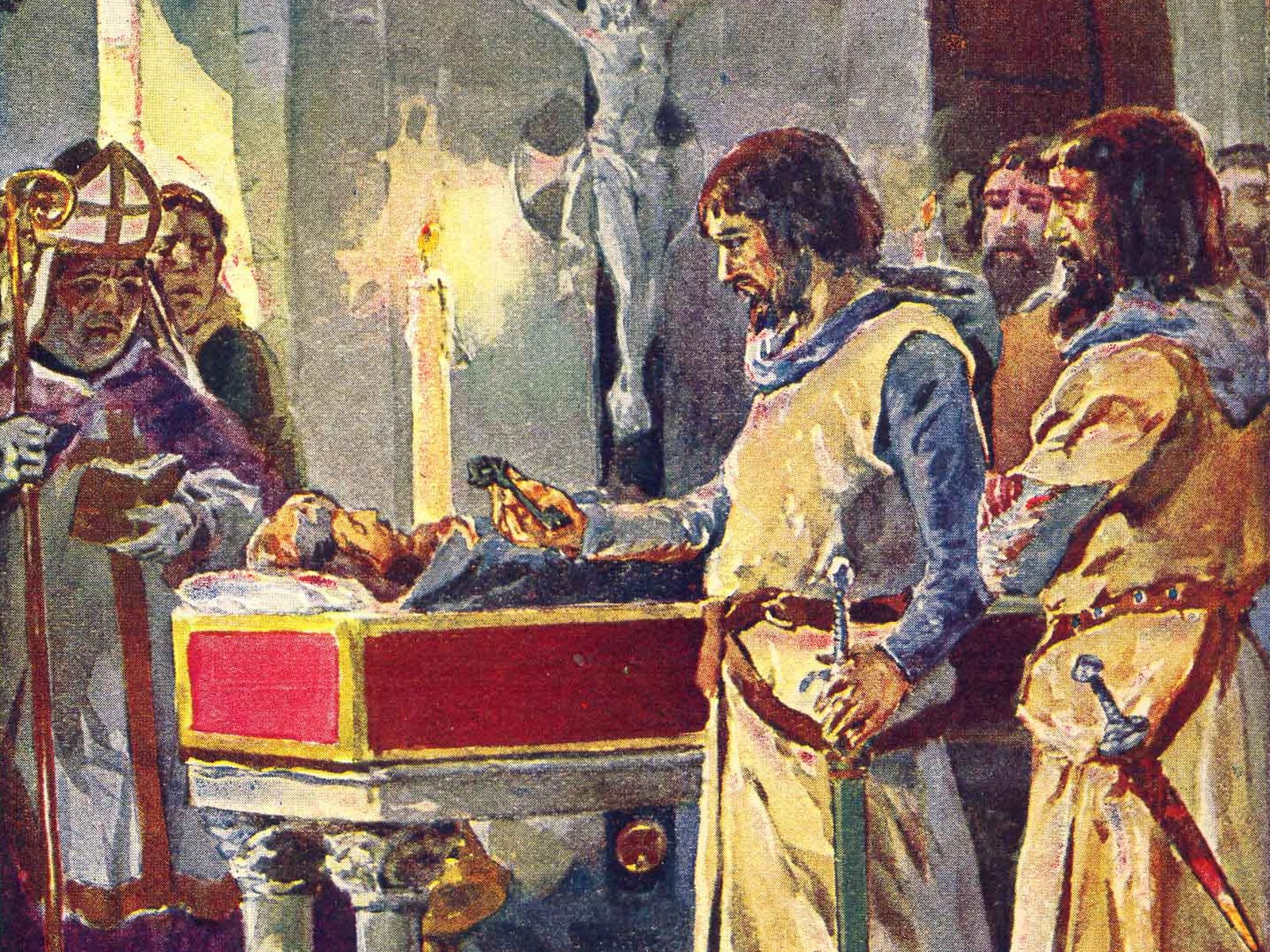
The story goes that Coimbra held out under siege to the very end, loyal to Sancho. The castellan, Martim de Freitas, had sworn to hand the castle over to no one but his king. When he heard Sancho had died, he didn’t believe it: he went to Toledo, had the tomb opened and saw the dead king with his own eyes. Then he laid the castle keys on the dead man’s right arm — keeping his oath by handing the castle to him — took them back, returned to Coimbra, and only then opened the gates to the new king.
But let’s be clear: this is legend. Nobody wrote it down at the time; it first appears in a chronicle of 1419, more than a hundred and fifty years later, and from there passed into Rui de Pina, the royal chronicler.
And the oldest source actually contradicts it. Herculano noticed that the Book of Lineages doesn’t mention Martim de Freitas at all — it says only that Coimbra stayed with Sancho “porque nom foy hi o conde, ca se hi vieera assy a filhara como as outras”: because the count never went there; had he gone, he’d have taken it like all the others. In other words: according to the Book of Lineages, there wasn’t even a siege — and no siege, no legend.
Herculano called Martim de Freitas “the symbol” — the symbol of all those who, when Sancho fell, kept their oath. Which is to say: he may never have existed, but there were people like him. A modern historian, Moreira, calls the story “essentially fictional” — but accepts that it fits a real fact: Coimbra really was a centre of resistance.
Incapable, or pushed?
Which leaves the big question: was Sancho II really incapable, or was he pushed aside by people who wanted power?
José Mattoso put it bluntly: “was there really anarchy? Didn’t the bulls exaggerate? Wasn’t it simply a struggle for power?” And he answered that there really was a crisis in society, made worse by the political crisis. Other, more recent historians put the emphasis elsewhere: on a deal between the bishops and the king’s brother.
Probably both are true. The kingdom was in disorder. And there was a brother waiting.