The flag of Portugal
Eight hundred years of quinas (little blue shields), castles, crosses, spheres and two colours born of a revolt. And a few legends along the way.
Before we start, a word of honesty: not a single medieval flag survives. What we know comes from seals hanging from documents, coins, books of arms and what the chroniclers wrote. The drawings for those periods are reconstructions — and we say so on each one.
-
c. 1139 – 1185
We still don’t know
Afonso Henriques
What banner did the first king carry? The truth is, nobody knows. Legend says that after the battle of Ourique he put a blue cross of five shields on his arms (his coat of arms) — one for each of the five kings he defeated — with thirty silver coins in each. The catch: that legend wasn’t written down until the 15th century.
How we know None of his banners survives. A 1183 document showing a "cross of twelve quinas" (the quinas are the little blue shields — more on them next) is a forgery. The full version of the legend comes from Duarte Galvão, in 1505.
-
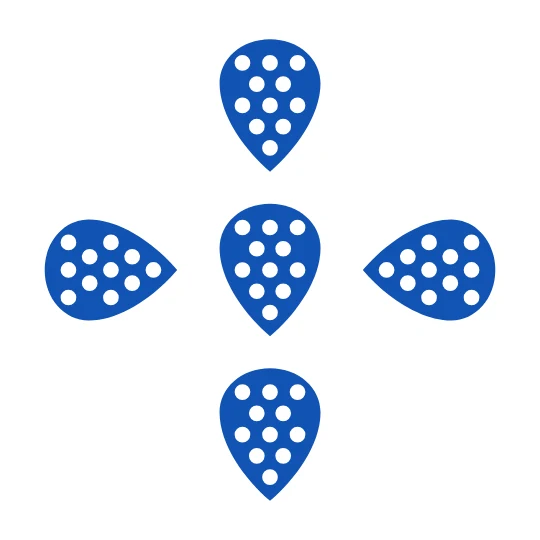
Reconstruction based on the seals 1185 – 1248
The quinas are born
Sancho I, Afonso II, Sancho II
The five blue shields in a cross, full of white dots — the quinas — already appear on the earliest known seal of a Portuguese king: that of Sancho I, from 1187–88. The number of dots in each shield still varied.
How we know From the seals that hung from documents, studied by N. Ávila Seoane (2020).
-
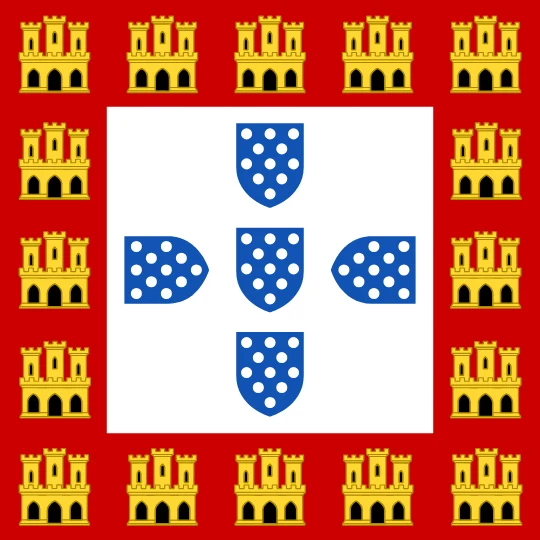
Reconstruction 1248 – 1385
The castles arrive
Afonso III to Fernando I
Afonso III adds a red border with golden castles around the quinas. Why? The chronicler Rui de Pina, around 1500, linked them to the Algarve. Today’s heraldists (the experts in coats of arms) say something else: the border marked someone who wasn’t head of the royal family — and before he was king, Afonso was the younger brother of King Sancho II.
How we know Rui de Pina says he saw the seals in the Torre do Tombo, and that the castles had no fixed number. The modern interpretation comes from Miguel Metelo de Seixas, of NOVA University Lisbon.
-
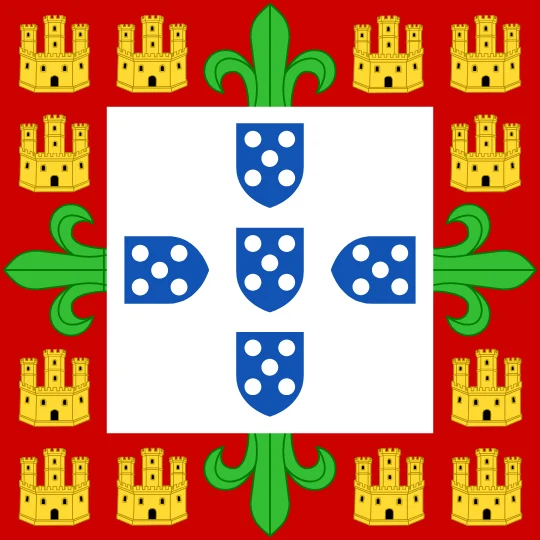
Reconstruction 1385 – 1485
The cross of Avis
João I, Duarte, Afonso V
João I had been Master (the head) of the Order of Avis, an order of knights. As king, he placed the shield of Portugal on top of the Order’s green cross, so that its fleur-de-lis tips stuck out beyond the shield. Later, says Rui de Pina, "through the painters’ negligence", the cross ended up drawn inside it.
How we know Rui de Pina, Chronicle of João II, chapter XIX.
-
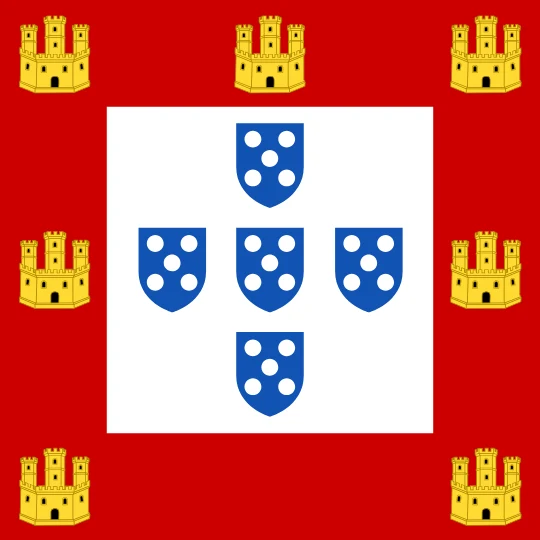
Reconstruction 1485
The quinas stand up straight
João II
João II removed the cross of Avis. And he noticed a detail: the two side shields lay on their sides, points towards the middle — it looked, says the chronicler, like the sign of a great defeat in battle. He had them all set upright, points down. They have stayed that way ever since.
How we know Rui de Pina tells of the change and says the gold coin called the "justo", struck in June 1485, already showed the upright shield.
-
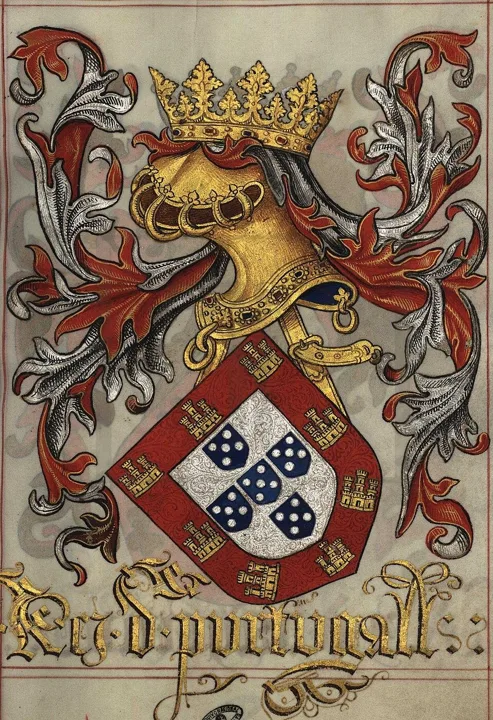
Period image: the king’s arms in the Livro do Armeiro-Mor, 1509 1495 – 1521
Manuel’s sphere
Manuel I
The armillary sphere — a globe made of rings, used to study the sky — was Manuel I’s personal emblem. In the age of the Discoveries, the royal arms, the sphere and the cross of the Order of Christ travelled together all over the Portuguese world. The sphere is still on today’s flag.
How we know From the books of arms of the time and M. Metelo de Seixas’s studies. Between 1578 and 1707 the crown and the shape of the shield kept changing, but we have yet to confirm those details in good sources — so we leave them out.
-
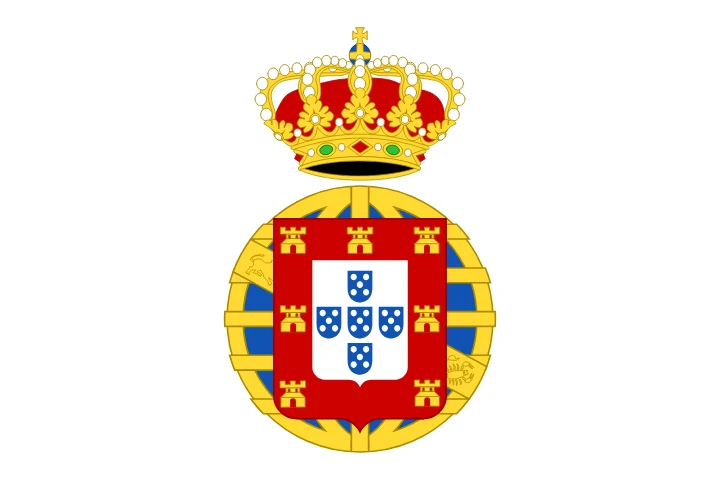
Reconstruction based on the 1816 law 1816
Portugal, Brazil and the Algarves
João VI
With the court in Rio de Janeiro, Brazil becomes a kingdom. The law of 13 May 1816 gives Brazil arms of its own — a gold armillary sphere on a blue field — and sets the crowned Portuguese shield inside that sphere: these are the arms of the new United Kingdom, for use on flags, seals and coins.
How we know From the text of the law itself — which even cites Afonso III as an example of a king who joined the arms of two kingdoms.
-
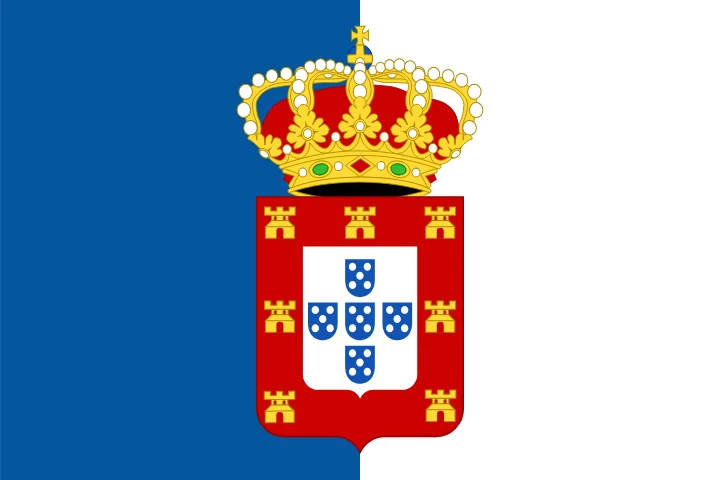
Reconstruction 1830 – 1910
Blue and white
Constitutional monarchy
Until then, the flag had mostly been white, with the royal arms in the centre. In 1830 a decree by the liberals — those fighting for a king bound by a constitution — split it into white and blue: blue next to the staff, arms in the middle. It was Portugal’s flag until 1910.
How we know From decree no. 22 of 18 October 1830, quoted by Trindade Coelho in 1906.
-
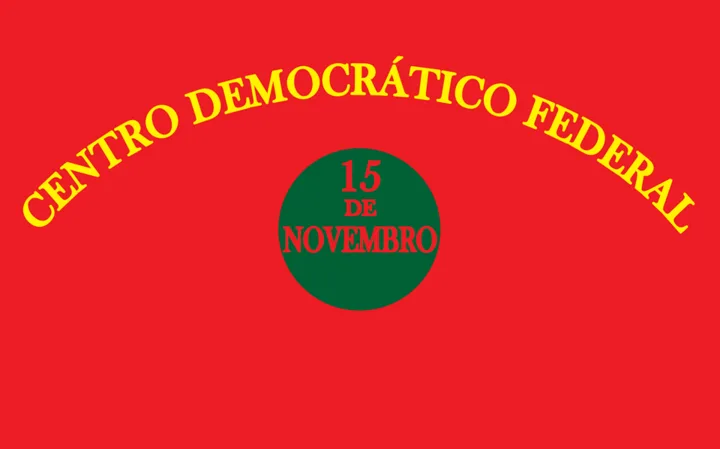
Flag of a republican club in Porto, after an illustration from 1901 1891
Green and red appear in Porto
The republican revolt of 31 January
On 31 January 1891, the republicans rise up in Porto. The revolt fails, but the colours stay: green and red become the colours of the republican cause.
How we know The Presidency of the Republic itself says the green and red of today’s flag "go back to the movement of 31 January 1891".
-
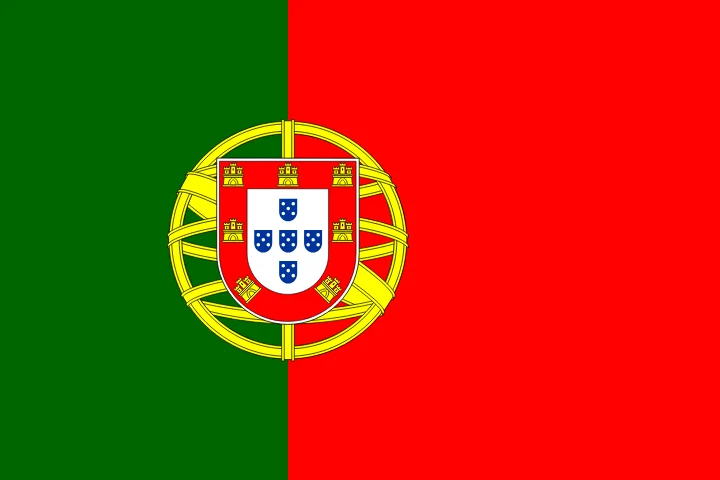
The national flag 1910 – 1911
Today’s flag
The Republic
On 5 October 1910, the revolution’s flag at the Rotunda, in Lisbon, had its colours the other way round: red next to the staff and green on the larger part. A commission — the painter Columbano Bordalo Pinheiro, the writer Abel Botelho, the journalist João Chagas and two soldiers who had taken part in the revolution — designed the new one. On 1 December 1910 came the first Flag Day. On 19 June 1911, the Constituent Assembly approved it by decree: dark green and scarlet, green next to the staff, the armillary sphere and the shield in the centre.
How we know Decree of 19 June 1911 and pages published by the Presidency of the Republic and its Museum. There was a row: Guerra Junqueiro and others wanted to keep the blue and white, and the Government refused to hold a plebiscite.
Legend or fact?
-
«The five quinas are the five Moorish kings defeated at Ourique.»
LegendA 15th-century legend. It appears in a book of heralds from 1416, grows in the chronicle of 1419 and is complete with Duarte Galvão in 1505. Camões put it into verse in The Lusiads.
-
«The white dots are Judas’s thirty pieces of silver.»
LegendAn old legend — and the sums don’t add up: five shields with five dots is twenty-five. Camões found a fix: he gets thirty by "counting the middle one twice".
-
«The seven castles are castles taken from the Moors.»
FalseFalse, says the heraldist Miguel Metelo de Seixas. Linking each castle to a place in the Algarve is "pure fantasy": the border of castles was a heraldic mark of Afonso III’s.
-
«Green is hope and red is the blood of those who died for the country.»
Half trueHalf true. The 1910 commission called red "a combative, warm, virile colour" — blood only came later. And green was there mainly because it was the revolution’s colour: the Presidency’s own archive admits the commission "could hardly justify" including it.
-
«The armillary sphere recalls Manuel I and the Discoveries.»
FactFact. It was Manuel I’s personal emblem, and the 1910 commission called it "the eternal marker of our adventurous genius".
And today?
The Constitution says, in Article 11, that the National Flag is the "symbol of the sovereignty of the Republic, of the independence, unity and integrity of Portugal", and that it is the flag adopted by the Republic of 5 October 1910. It is one and a half times as long as it is high; green takes two fifths and red the other three. And 1 December, the first Flag Day in 1910, is now a public holiday: Restoration of Independence Day.
Want to know who these kings were? See the family tree of the kings of Portugal →
Sources
- Rui de Pina, Chronica d'El-Rei D. Affonso III, cap. I — Projeto Gutenberg; Chronica d'ElRey D. João II, cap. XIX — archive.org
- Duarte Galvão, Chronica de el-rei D. Affonso Henriques (1505) — archive.org
- N. Ávila Seoane, «Las quinas en la validación de los reyes de Portugal, 1448-1910», Ler História 77 (2020) — OpenEdition
- M. Metelo de Seixas, citado em Observador (fact-check); «Overseas Elements in Portuguese Armorials», e-JPH 15:2 (2017)
- Carta de Lei de 13 de maio de 1816 — texto original
- Trindade Coelho, Manual politico do cidadão portuguez (1906), pp. 211–212 — archive.org
- Camões, Os Lusíadas, III.53–54 — Projeto Gutenberg
- Presidência da República, «Bandeira Nacional» (decreto de 19 de junho de 1911, art. 11.º da Constituição); Museu da Presidência; Arquivo Jorge Sampaio
- Drawings: Wikimedia Commons (public domain and CC0) — reconstructions by UVA Cads and others; Livro do Armeiro-Mor (1509)