Sit down, this one has a witness: a priest who was there and wrote it all down. But before he arrives, we need to set the scene.
First, the map
It’s 1147. The king is Afonso Henriques — the boy who went to war against his mother in episode 1.1, and who in 1140, after Ourique, started calling himself king on his own authority.
His kingdom is still small. The north, from the Minho down to the Tagus at Santarém, is Christian. Further south lay Muslim territory, al-Andalus. That year, on 15 March, Afonso had taken Santarém by surprise in a night attack. But lower down, at the mouth of the Tagus, lay the big, rich, well-walled city he really wanted: Lisbon.
He had already tried to take it a few years earlier, around 1142, also with foreign help. It went badly. On his own he had neither the men nor the ships to besiege a city like that.
Who the crusaders were
Meanwhile, on the other side of Europe, the Second Crusade had begun. The Christians had lost Edessa, one of the cities they held in the Middle East, and Pope Eugenius III called Christendom to arms. The monk Bernard of Clairvaux went round Europe preaching it.
Many people set off overland. But in the north — England, Flanders, the region around Cologne in Germany — there were plenty of sailors and merchants used to the sea. They went by ship. It was a long way round: down Europe’s Atlantic coast, through the Strait of Gibraltar, across the whole Mediterranean to the Holy Land and Jerusalem.
Along the way they had to stop for water and food. And the Portuguese coast was right on the route.
In spring 1147 a huge fleet sailed from Dartmouth, in the south of England: English, Normans, Flemings and men of Cologne. Our witness counts some hundred and sixty-four ships. There were hardly any nobles: they were mostly men from the ports, organised in a kind of sworn association, with their own rules, and judges they elected themselves to share out the profits.
On one of those ships was our priest. We don’t know his name. For centuries he was called Osbern; later, scholars proposed a crusader-priest named Raol. Neither identification is secure — so here he’ll simply be our priest. We do know he wrote everything down, in Latin, in a long letter. Thanks to him this story has details no Portuguese chronicler ever told.
The salesman bishop
The voyage started badly. In the Bay of Biscay, on the night of the Ascension, they were caught in a storm so violent the priest swears he heard sirens: first wailing, then laughter, like soldiers jeering in a camp.
On 16 June they reached Porto. The king wasn’t there: ten days earlier, knowing the fleet was on its way, he had set off with his army to besiege Lisbon. But he had sent the bishop of Porto, Pedro Pitões, a letter telling him what to do — and the letter had reached the bishop only the day before.
The next day the bishop gathered all the crusaders on top of the hill, in the cathedral churchyard, and preached them a sermon. The priest copied it down. It’s a masterpiece of salesmanship: it starts with God and faith and ends with the offer. If they stayed to help the king until Lisbon fell, there would be money from the royal treasury — as much as the treasury allowed. And if they wanted guarantees, the bishop himself would go with them as a hostage.
At Porto there wasn’t much argument: they waited for the ships the storm had scattered and sailed south to hear what the king had to say.
The deal
It was at Lisbon, face to face with the king, that things turned sour. Some had been on the failed attempt of 1142 and hadn’t enjoyed it — and they threatened to sail on. The account’s modern translator sums up the tone of the talks well: they treated the king of Portugal without much ceremony and haggled over the terms. In the end Afonso Henriques signed a charter, which the priest copied word for word. It said this:
- The crusaders who stayed for the siege would take everything belonging to the enemy. The king and his men would get none of it.
- If they wanted ransom for prisoners, the money was theirs; the prisoners went to the king.
- If they took the city, they could search it and plunder it as they liked. Only then would they hand it over to the king.
- Anyone who wanted to settle in Portugal would get land, under the laws and liberties they were used to.
- And their ships, and their heirs’ ships, would be free of tolls forever in the kingdom’s ports.
In short: Afonso got the city, and the crusaders got everything inside it. Hostages were exchanged to seal the deal. The siege could begin.
The siege
First, though, there was talk. The archbishop of Braga and the bishop of Porto went to speak to the people inside, at the foot of the wall, and called on them to surrender. An old Muslim answered them from the top of the wall with a line that says a lot: “How many times now within our memory have you come hither with pilgrims and barbarians to drive us out?” The bishop of Porto didn’t deny it.
A word of warning: the account’s own translator says that these speeches were probably composed by the priest, in the manner of ancient historians. But the old man’s line matches what we know: it wasn’t the first time.
The priest reports what the city’s governor told him afterwards: inside there were supposedly a hundred and fifty-four thousand men, not counting women and children, including people who had fled from Santarém, Sintra, Almada and Palmela. That’s almost certainly an exaggeration. But the next detail isn’t: there were lances and shields for only fifteen thousand, and the streets were so narrow that, apart from the merchants’ quarter, hardly any was more than eight feet wide. About two and a half metres.
Four months of siege
The siege lasted four months, and it was ugly.
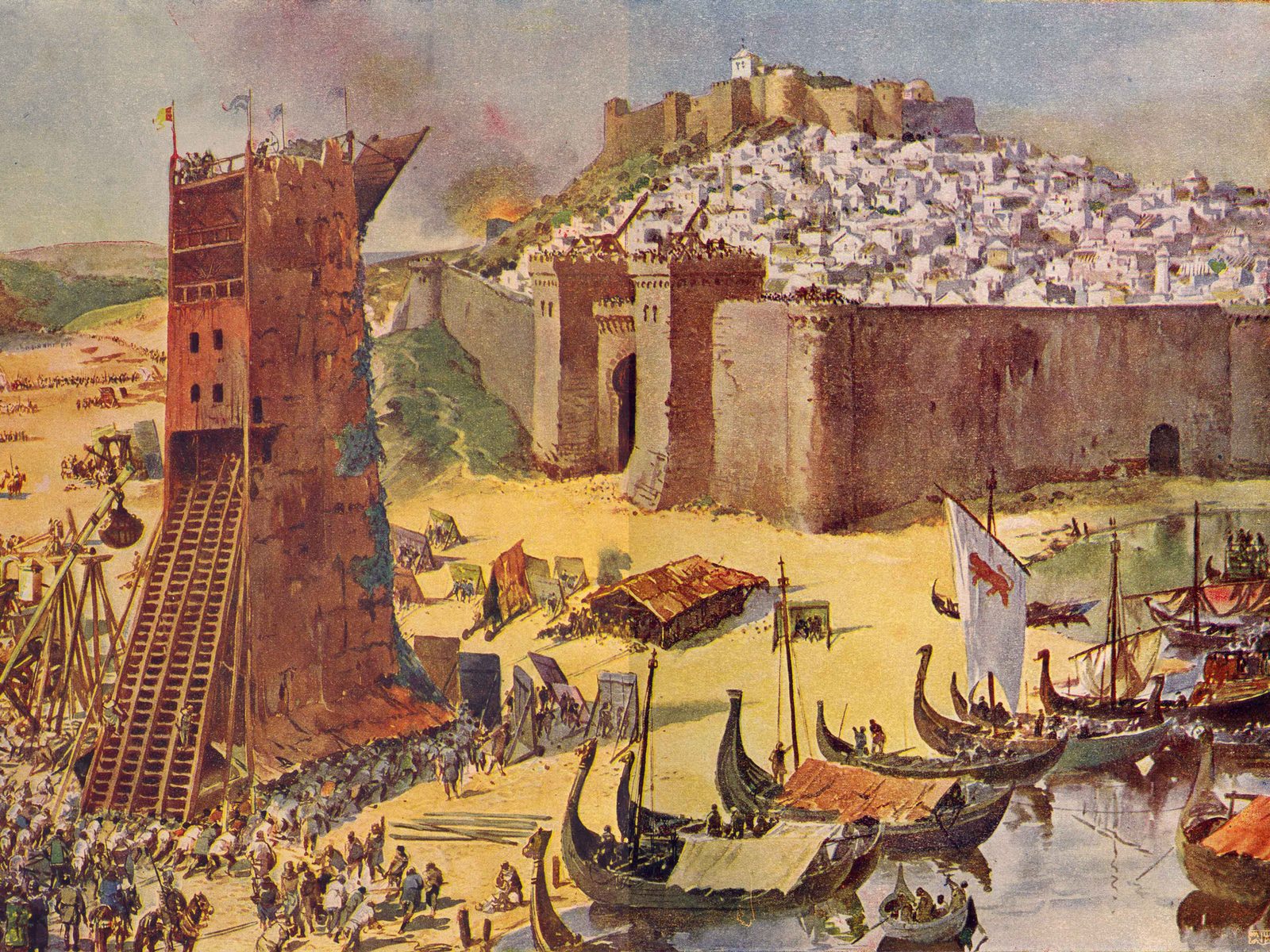
After six weeks, the people inside were starving. The crusaders hauled their ships up on land and lowered the masts — a message for anyone watching from the walls: we’re staying for the winter.
The men of Cologne dug mines under the wall five times. All five failed. Later they dug one with five entrances, which took a month and finally brought down a stretch of the wall.
Inside, the priest writes, hunger and the stench of the dead tormented everyone, because there was nowhere left to bury them. They ate the refuse the crusaders threw from their ships, carried by the tide to the foot of the walls.
The crusaders built a siege tower, the archbishop blessed it, and another priest (not ours), holding a piece of the True Cross, swore to stay inside it with them as long as he lived. The tower reached the wall near the Iron Gate. That night the tide came in, surrounded the tower and cut it off from the rest of the army. The defenders came out through the gate in two columns, and from the top of the wall they hurled wood, pitch, flax, oil — anything that would burn — at the tower.
Between the tower and the wall was a penthouse of woven wicker, which they called a “Welsh cat”. Seven young men from Ipswich spent the night holding it in place. Under it, other men, helped by those inside the tower, beat out the fire piece by piece. The tower held.
At the end of October, Lisbon surrendered. The terms let the people inside keep their lives, and the governor his property.
What the priest didn’t hide
The entry was a celebration. The archbishop in front with the banner of the cross; the cross raised on the highest tower; the Te Deum sung through tears. The king walked round the walls of the castle on foot.
And then, the priest writes, the men of Cologne and the Flemings saw so much to take that they forgot their oath. They ran this way and that, broke down doors, emptied houses, abused the citizens and the young women. They killed the city’s old bishop — the bishop of the Christians who had lived in Lisbon under Muslim rule — by cutting his throat. The count of Aerschot seized the governor’s mare by force, and the mare lost her foal.
The English and the Normans, the priest assures us, stayed quietly at their posts. Then again, the priest was on the English side, and we don’t have the Flemish version.
What was left
Then the crusaders split up. Some sailed on — and some stopped at Tortosa, in Catalonia, to help with another siege. Others stayed — the deal had promised land to anyone who wanted to settle. One of them, the Englishman Gilbert of Hastings, was made bishop of the new Christian Lisbon.
Afonso Henriques got the city that would become the kingdom’s capital. And a priest whose name we can’t be sure of left the fullest account we have of the birth of Portuguese Lisbon — with the courage to tell his allies’ shame as well, though he spared his own side.
It was, as an English chronicler of the time, Henry of Huntingdon, put it, a victory of “lesser folk who were dependent upon no great leader except omnipotent God”.