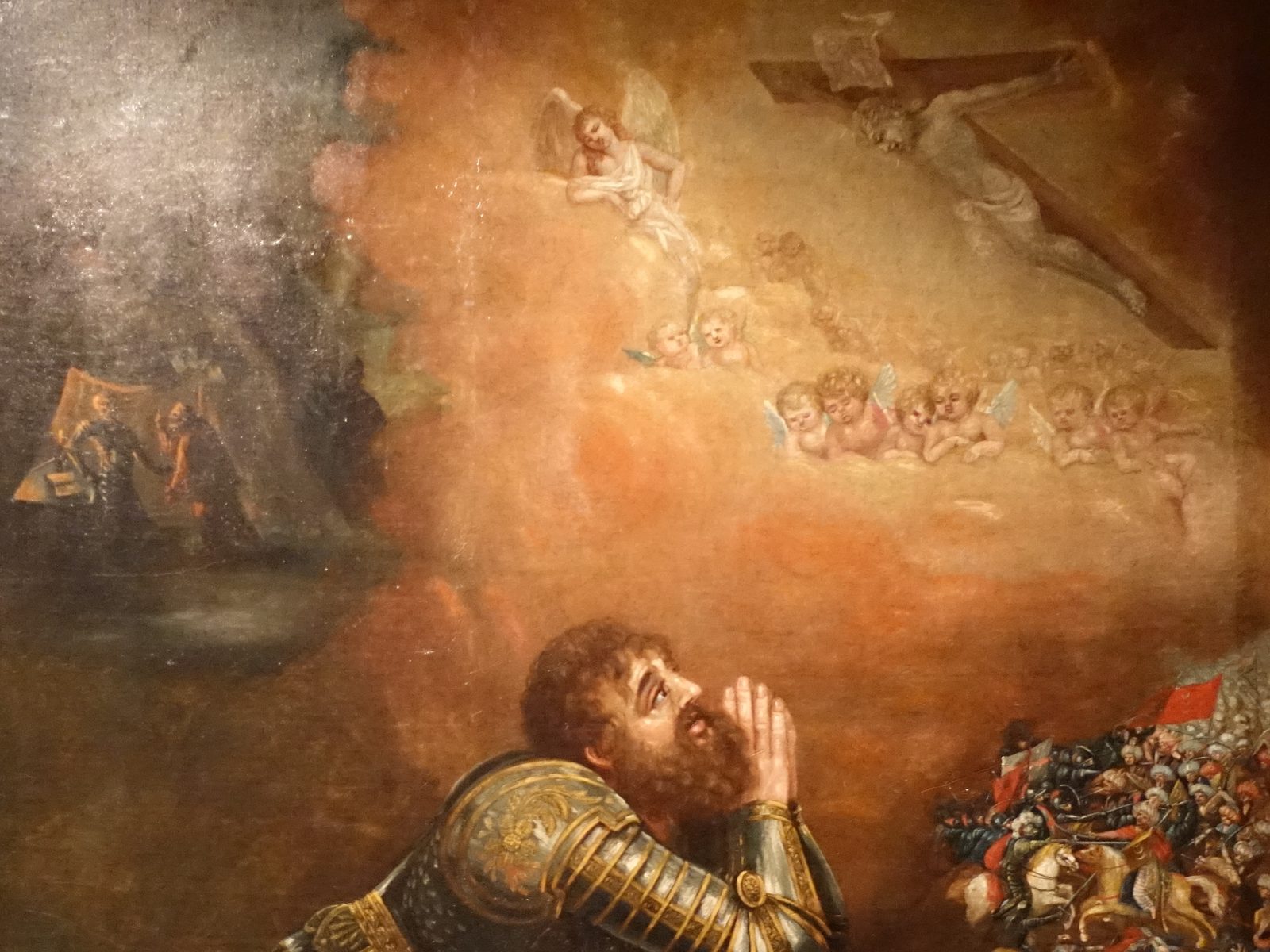
Sit down, this one’s about a battle and a legend. The legend first, because it’s the one everybody knows.
The legend
Summer 1139. Afonso Henriques, still a count, is in the south with his men, facing a much bigger Muslim army. On the evening before the battle, a hermit comes and tells him to go out alone when he hears the bell of the hermitage ring. Afonso prays and falls asleep. An hour before dawn, the bell rings. He goes out, the sky opens, and Christ crucified appears to him on a huge cross, promising him victory and a kingdom.
Duarte Galvão, King Manuel’s chronicler, who told this version in 1505, says Afonso even protested: “Lord, appear to the heretics, to the heretics — for I believe without any doubt.” In other words: show yourself to the ones who don’t believe; I already do.
The next day, before the fight begins, his soldiers hail him as king. Afonso defeats five Moorish kings. And he puts five shields on his banner.
For four hundred years the Portuguese learned this as true history. It was in the books, on the tiles, in the paintings in the churches.
Now let’s see what we actually know.
What the sources of the time say
The date. The battle was on 25 July 1139, the feast of St James.
The kind of battle. Afonso had probably ridden a long way south, on one of the yearly raids Christians made into Muslim territory to plunder and come home again. The historian Alexandre Herculano, whom we’ll meet later, found a document in which Afonso himself calls this campaign a “fossado” — the word for those raids.
The enemy. The Christian chroniclers call the Muslim leader Esmar. Herculano thought it was a garbling of Omar or Ismail.
The five kings. Here’s the surprise: the five kings were not invented later. They already appear in a 12th-century text, a life of St Theotonius — prior of the monastery of Santa Cruz in Coimbra, one of Afonso’s trusted men — written by someone who knew him. It says Afonso defeated “five pagan kings” on the field of Ourique, with God’s help and the protection of St James. But Herculano explains the trick: when a Christian chronicler called a Muslim a “king”, he meant a leader — a governor, a local commander. Five chiefs, promoted to kings by the writer’s pen.
The women. Another chronicle from the same century records that on the Muslim side women fought “in the manner of Amazons” — you could tell from those found dead on the field. Herculano says it was an Almoravid custom.
The title of king. Between July 1139 and June 1140 not a single document issued by Afonso himself survives. One private deed does, dated 1 October 1139, and it still calls him infante — a prince, not yet a king. It was the following year that he started signing as king. Nobody gave him the title — we saw that in episode 1.1. He used it until the world got used to it.
The place. Nobody knows for sure where it was. Tradition says Ourique, in the Lower Alentejo, land that later belonged to the Order of Santiago. The archaeologist Jorge de Alarcão points out that the knights of Santiago had every reason to want a battle there, fought on the feast of St James, their patron saint. He thinks a Campo de Ourique near Leiria is more likely — though he won’t swear to it.
In short: God’s help and St James’s, yes — people said that of any victory. Christ in the sky? Not a line.
How the legend grew
The legend grew in layers, like an onion:
- Around 1340, a chronicle from the monastery of Santa Cruz in Coimbra already says that after Ourique Afonso called himself king and took the five shields as his arms. No Christ yet.
- In 1419, in a chronicle of the kingdom, the apparition of Christ shows up for the first time — “the oldest narration of the legend known to date”, in the words of the philologist Lindley Cintra. Nearly three hundred years after the battle. The historian Ana Isabel Buescu dates the legend’s origin to that same 15th century.
- Over time, the numbers grew too. Someone eventually wrote that four hundred thousand Saracens had been defeated.
- In 1597, in Pedro de Mariz’s Diálogos de Vária História, a document was printed — copied, it was said, from the archive of the monastery of Alcobaça — claiming to be the oath of Afonso Henriques himself, recounting the miracle.
The oath someone forged
The oath was a fake. But it’s worth seeing what it said, because it’s pure theatre.
It was dated Coimbra, 29 October 1152, written by a scribe, with witnesses — one of them St Theotonius himself. It had everything: the hermit who had lived sixty-six years among the infidels, the bell, Afonso throwing down his shield and sword and taking off his clothes and shoes to lie face down on the ground, a cross almost ten cubits high.
And it ended with a prophecy: God would watch over Afonso’s descendants down to the sixteenth generation; in that generation the line would dwindle — but even then, God would turn his eyes to it again.
Notice when the document appeared. Since 1580 the king of Portugal had been the king of Spain. It’s hard not to read a message here: a prophecy like that was exactly what anyone dreaming of a Portuguese king wanted to hear. (Later, after 1640, some said the sixteenth generation was King João IV.)
Herculano looked at the document and wrote that it was “so badly forged that the least instructed student of diplomatics will reject it as false at first sight”. And he added that anyone could go and see it in the National Archive, where it was kept. Before him, the Academy had already taken it apart.
Now, honesty: the legend didn’t serve just one side. When Philip III of Spain — Philip II of Portugal — entered Lisbon in 1619, one of the triumphal arches that greeted him had the miracle of Ourique as its centrepiece. It worked both for those dreaming of a Portuguese king and for the Spanish king who wanted to look like Afonso Henriques’s heir.
The man who said no
Herculano wasn’t the first to doubt it. In the 18th century the priest Luís António Verney and the architect Luís Nunes Tinoco had already questioned the miracle. But Herculano was the one who paid for it.
In 1846 he published the first volume of his History of Portugal. He dismissed the miracle in a single line — “fables no less absurd than brilliant” — and took the oath apart in the notes at the back.
That was enough. Attacks poured in from the newspapers and the pulpits. On 30 June 1850 Herculano replied with an open letter to the Cardinal Patriarch of Lisbon, D. Guilherme Henriques de Carvalho, titled Eu e o Clero — “The Clergy and I”. A pamphlet war followed that went on for years.
He didn’t back down. Go to the documents, see what’s there, say what’s record and what’s legend — that’s more or less what this site tries to do. With fewer pamphlets.
What was left
Ourique was a real victory over five Muslim leaders — “kings”, the source from the time calls them — by a count who, the following year, started signing himself king. The rest — the hermit, the bell, the Christ on the cross, the oath — was added by people who needed a grander beginning.
We tell the legend anyway, because legends also say who we are. This one says that, for centuries, a small country needed to believe it had been chosen.
Herculano left the last word in the book’s foreword: “if we do not have the generous courage to tell ourselves the truth, strangers will come and tell it to us with crueller frankness.”