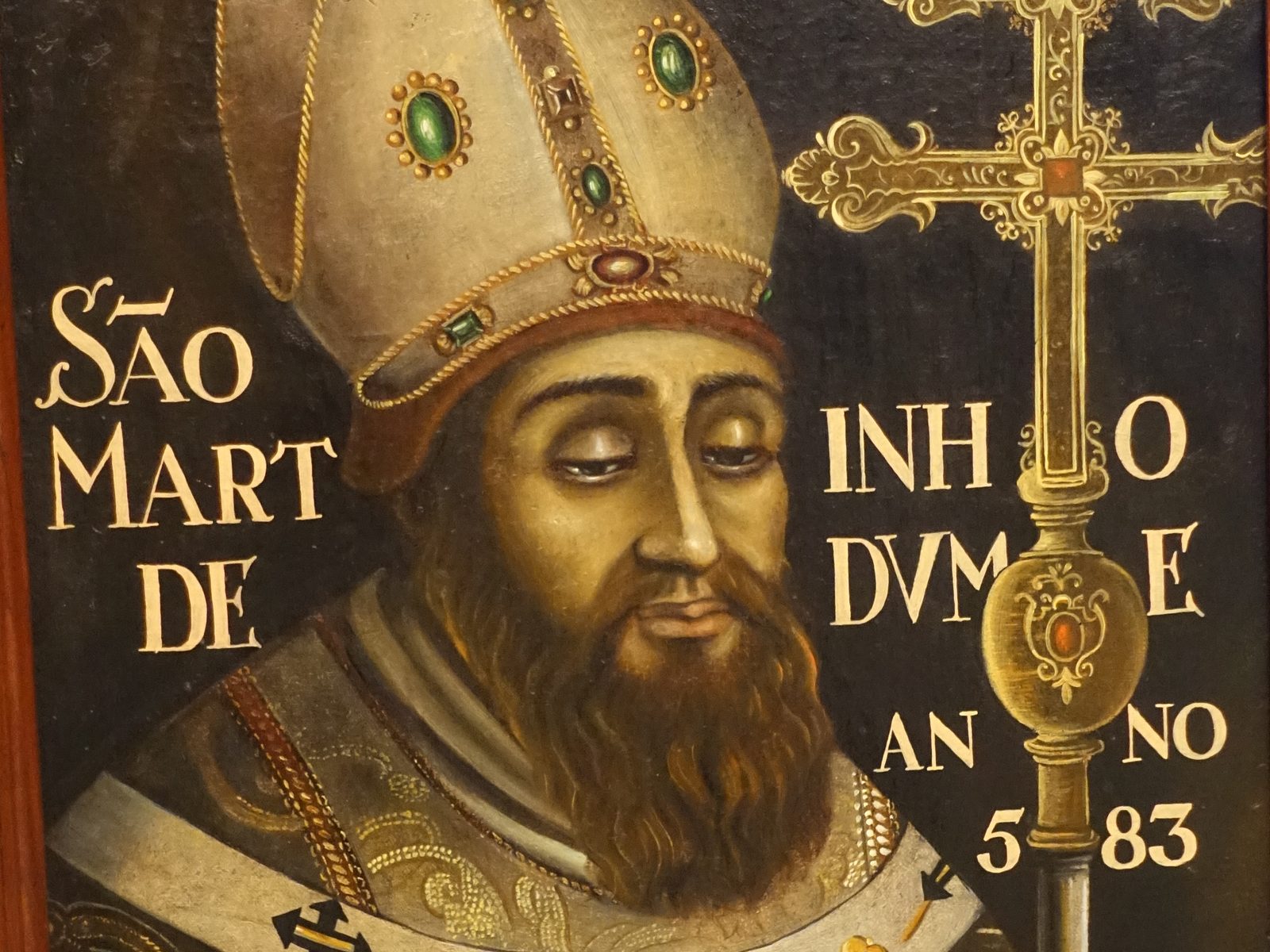
Sit down, this one comes from far away. Around the year 550, a foreigner arrives in the Minho. Back then it wasn’t called the Minho, or Portugal: it was Gallaecia, a land that ran from the Douro to the far end of Galicia.
Gregory of Tours, who wrote about him a few years later, says he was born in Pannonia, roughly where Hungary is today, that he went east to visit the holy places, and that he studied so hard he had no equal in his time. Thing is, some Portuguese scholars doubt this whole biography. Either way, one day he got on a boat to the end of the known world.
His name was Martin. He’ll go down in history as Martin of Dume, and later of Braga. And his name will be tied to something no king, no army and no emperor ever managed: changing the way the Portuguese say the days of the week.
But first we need to explain who ran this land when he arrived. Because it wasn’t the Romans.
The Suebi
On the last day of 406 — some say 405 — several Germanic peoples crossed the Rhine, the empire’s frontier, and never stopped. A few years later they crossed the Pyrenees. In 411 they divided up the Peninsula by lot — literally, they drew lots for the provinces. Gallaecia went to two of them: the Vandals and the Suebi. The Vandals eventually moved south, killing some people in Braga on their way out. The Suebi stayed.
They made Braga their capital. The city Augustus had founded for the Bracari became the capital of a Germanic kingdom.
We know almost all of this thanks to one man: Hydatius. He was born in the 390s in the Limia, the upper valley of the river Lima, on the Galician side (it’s the river from the forgetting episode). He was most likely bishop of Chaves. He wrote a chronicle of his times the way you’d keep a war diary. The Suebi, he said, were, as always, false to their promises. And being caught in the middle cost him: on 26 July 460, acting on the word of informers, a Suebic chief called Frumarius seized him inside his own church at Chaves. He was held for three months, went home in November and kept writing.
The Suebic kings had their moments. Rechiar was, as far as we can tell, the first Germanic king to be Catholic, and the coins that survive show he was the first to mint them in his own name. It didn’t last. In 456 the Visigoths beat him near Astorga. Rechiar fled, wounded, and was caught at a place which, Hydatius writes, they called Portucale. They killed him in December.
Before that — on Sunday 28 October of that same year, 456, while Rechiar was on the run — the Visigoths entered Braga. Hydatius tells us: churches broken into, altars smashed, the clergy stripped, and the holy places full of pack animals, cattle and camels.
The king who weighed his son in gold
By the time Martin arrived, a century later, the Suebi had become Arians — a version of Christianity Rome considered heresy. And this is where Gregory of Tours tells of a miracle.
The Suebic king, Chararic, had a son at death’s door. The king sent gold and silver to the tomb of Saint Martin in Tours, matching his son’s weight. It didn’t work. Gregory explains why: the king was still an Arian.
So the king had a church built in Saint Martin’s honour and promised to believe what the Catholic priests taught. He sent his men again. This time they weighed a silk cloth, left it on the tomb overnight, and in the morning it weighed more. They brought it back by ship, as a relic.
And, says Gregory, on the very day the relics left Tours, the other Martin set out from his homeland — and they arrived together at the port in Gallaecia. The boy was cured.
It’s a miracle, of course, told by someone with every reason to tell it. And Gregory is the only one who mentions this king: Isidore of Seville credits the Suebi’s conversion to another, Theodemir, and some historians think they were the same man. But it’s the story people told.
Martin founded a monastery at Dume, on the edge of Braga, helped bring the king and court back to Catholicism, became bishop of Braga and presided over the city’s second council, in 572.
Candles, bread and mice
What makes him unforgettable is a small book, written after that council at the request of a fellow bishop. It’s called De correctione rusticorum: on correcting the country folk. On the very first page Martin says he’ll season peasants’ food with peasants’ language. And, without meaning to, he left us the best portrait of the people of the Minho fifteen hundred years ago — because, to tell them what not to do, he wrote down exactly what they did.
They lit candles to rocks, trees and springs, and at crossroads. They threw bread into springs. They poured food and wine on the fire, over the burning log. They celebrated the Kalends of January, decorated their tables and put out laurel. The women called on Minerva at the loom. They chose Venus’s day — our Friday — to get married. They read signs in birds and sneezes. And they held feasts for the moths and the mice, so that for the rest of the year they’d spare the bread and the clothes in the chest. Martin answered with a farmer’s common sense: if the bread isn’t shut away properly in the chest, the mice will eat it, however many feasts you throw them.
In the rivers there were lamias, in the springs nymphs, in the woods dianas. The farmers had been baptised, yes. But they still lived in a world full of gods.
The days of the week
One complaint in the book ended up tied to the Portuguese language.
Martin couldn’t stand baptised people calling the days of the week the day of Mars, of Mercury, of Jupiter, of Venus and of Saturn. Those were the names of demons, he wrote. There were even Christians who said they kept Jupiter’s day. And Martin shamed them: the pagans stopped work on Jupiter’s day, while the Christians didn’t even respect Sunday. For him, that was the day to keep: no ploughing, no meadow or vineyard work — but cooking and travelling were allowed.
Martin didn’t propose new names. He only complained about the old ones. The alternative already existed: the Church counted the days as feria secunda, feria tertia, feria quarta — the second day, the third, the fourth. Hydatius himself, a century earlier, already dated some events that way, and a Christian inscription from Braga from the year 618 reads die secunda feria.
In Spain, France and Italy, the gods stayed. The Spanish still say martes (Mars), the French mercredi (Mercury), the Italians giovedì (Jupiter).
Here, the Church’s version won. Segunda-feira, terça-feira, quarta-feira, quinta-feira, sexta-feira — second, third, fourth, fifth and sixth day. Portuguese is the only Romance language that made this the rule — Galician, its cousin, still keeps both forms.
Now, honesty: there’s no document that says “Martin of Dume changed the names of the days”. There’s his complaint, in writing, and there’s the result. Tradition credits the victory of the Church’s names to his work, and it may well be right — but it took centuries, not a decree.
The end of the kingdom
Martin died in 580. By the end, the Suebi were fighting among themselves: one Andeca took the throne from the king, still a boy, and shut him in a monastery. In 585 the Visigothic king Leovigild marched into Gallaecia, deposed Andeca, shaved his head and made him a priest by force. Isidore of Seville thought it fair: he suffered what he had done to his own king.
From 411 to 585 is 174 years — Isidore, who counted another way, says 177. Nearly two centuries with its capital in Braga. Then the Suebi vanished from history almost without a trace.
Almost. They left a basilica at Dume, a few coins, and a foreign bishop who took the gods out of our week.
The gods of the springs stayed.