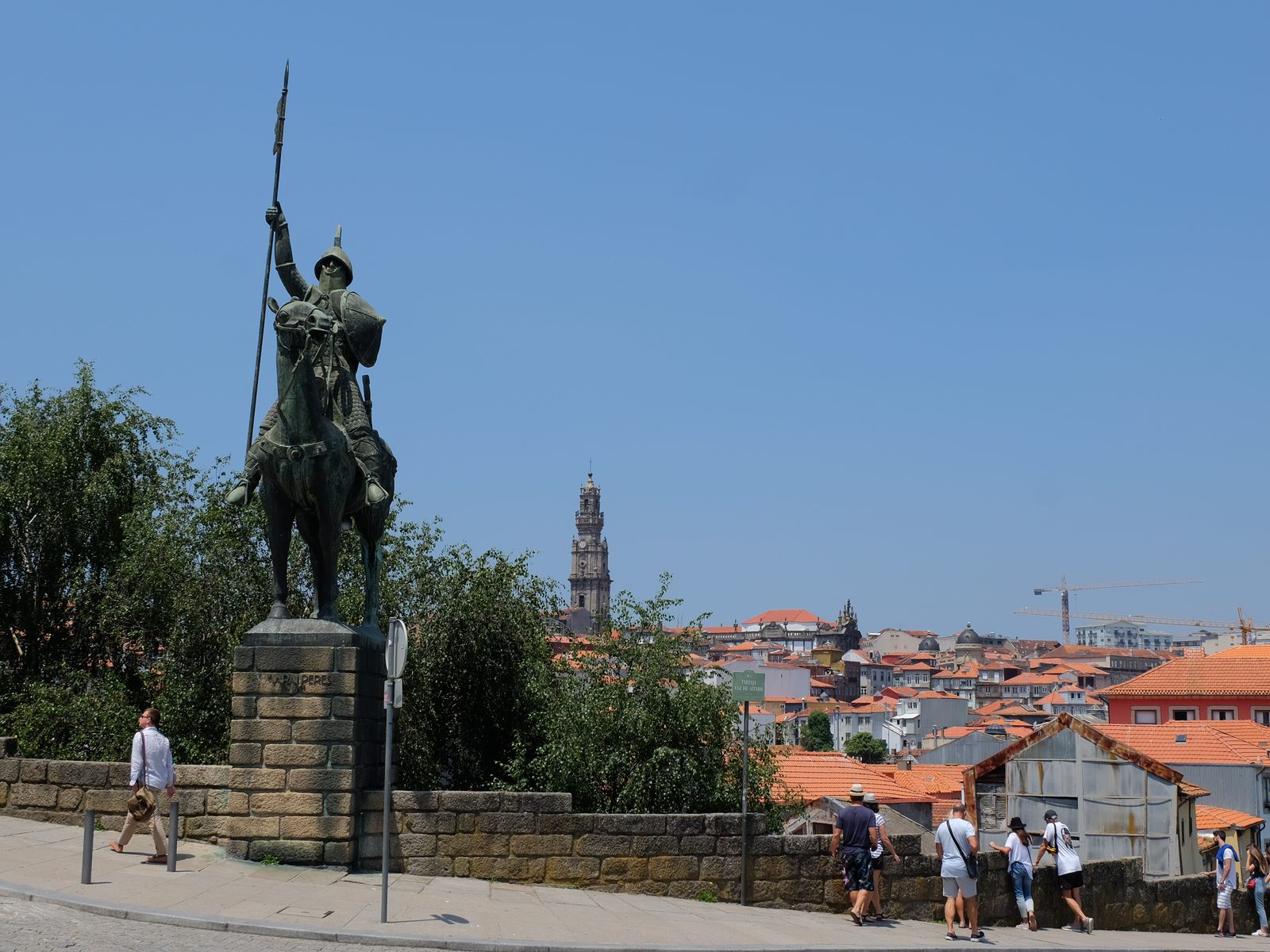
Sit down, this is the last one before the beginning. The year is 711, in the south of the Peninsula. An army from North Africa, led by a commander called Tariq at the head of Berber troops, lands beside a rock that still bears his name: Gibraltar, Jabal Tariq, Tariq’s mountain.
Roderic, king of the Visigoths — the same Visigoths who, in the last episode, swallowed the kingdom of the Suebi — marches out to meet him. He loses the battle (by the river Guadalete, says the traditional account; the exact spot is still argued over) and vanishes. Within a few years almost the whole Peninsula is in Muslim hands.
Almost. Up in the mountains of Asturias, a band of Gothic nobles and hill-folk refuse to surrender. It’ll take them centuries to come back down.
The place they call Portucale
To understand where the name Portugal comes from, we need to go back about two hundred and fifty years.
In the last episode, the Suebic king Rechiar fled the Visigoths and was caught in Porto. When the chronicler Hydatius tells the story, he writes that they caught him at a place they call Portucale.
It’s one of the first times the name appears in writing.
Portucale was the port of Cale. Where exactly Cale was has long been argued over: some put it on the south bank, where Gaia is today; more recent archaeology has found the oldest settlement on top of the cathedral hill in Porto, the Penaventosa. Most likely the name ended up covering both banks of the river.
And what did Cale mean? Nobody knows for sure. Some say it comes from the Callaeci, some talk of a goddess, some swear it’s Greek for beautiful. Nobody has proved anything. But the name stuck to the port, then to the city, then to the land around it.
Portucale. Portugale. Portugal.
No man’s land
The Muslims reached the north, but they didn’t stay long. Around 741 a great Berber revolt against the Arab chiefs broke out across al-Andalus, and Muslim power never took hold again north of the Douro. The north was left without a master.
And the king of Asturias, Alfonso I, made the most of it. The chronicle written at the court of his descendants says that, with his brother Fruela, he took Lugo, Tui, Porto, Braga, Viseu, Chaves and many other towns, killed the Arabs he found there and took the Christians back with him to the mountains.
From this the textbooks drew a very tidy story: the Douro valley was left empty, a wall of desert between Christians and Muslims, and for over a hundred years nobody, supposedly, lived between the Minho and the Douro at all.
There’s one problem with that version
That story is very probably overdone.
It’s not a settled matter, mind: historians have been arguing about this for more than a century. Alexandre Herculano read the oldest chronicles and believed in the desert. Alberto Sampaio thought it impossible — but he leaned on documents that later scholars had to reject as forged or badly copied. Some historians still argue for depopulation.
But archaeology has changed the conversation. Luís Fontes, of the University of Minho, sums up what most now accept: the land between the Minho and the Douro kept a good part of its people until the second half of the 9th century, with no working state power at all. The land wasn’t empty: it was kingless.
In other words: when the Christians from the north came down to “repopulate”, in many places they found people already there. People without documents, without a lord and without a chronicler — and so, for a long time, invisible to history.
The birth certificate
In 868, a nobleman in the service of King Alfonso III of Asturias came down to the Douro and took possession of Portucale. His name was Vímara Peres.
We know this from one line. Just one, in Latin. The copy we have was made in the early 12th century, on a blank page of a book from the monastery of Lorvão. But the French historian Pierre David thinks the copyist was working from notes written by a monk of the 9th century itself — someone who lived through it:
Prenditus est Portugale ad Uimarani Petri. Portugal was taken by Vímara Peres.
It was the same Pierre David who called these notes — this one and the one about Coimbra ten years later — “the birth certificate of Portugal”. Note that the line gives Vímara no title, whereas in the Coimbra note the same hand calls the man who took the city a count. Historians call Vímara the first count of Portucale; what’s certain is that he’s the first lord of that land we know of.
It wasn’t an epic battle. It was what they called presúria: you arrived in a land with no master, put a garrison in, organised the people who lived there, and the land became the king’s — and the taker’s.
That Guimarães
Further inland there’s a place that appears in the documents as Vimaranes — a name formed from a Germanic personal name, Vímara: “Vímara’s estate”. Over the centuries Vimaranes became Guimaranes, and Guimaranes became Guimarães.
Yes. That Guimarães.
Whether that Vímara was Vímara Peres himself is another question. And here, honesty: it’s almost certainly named after a Vímara. That it was this one is the likeliest answer — the county’s most important place being called “Vímara’s”, like its first lord, would be quite a coincidence. But no document proves it, Vímara wasn’t a rare name at the time, and some historians, such as Torquato de Sousa Soares, doubted it was the same man.
In 873, another line in the same book: the king came to a place called Varna and, on the sixth day, Vímara died. Where is Varna? Nobody knows for sure. Pierre David thought it was the old name of the hill at Guimarães — and that Vímara died there, at home. Other historians disagree.
The rest of the county
The lords who came after him ran that land for two centuries, sometimes loyal to the kings of León, sometimes not so much. A countess called Mumadona, widow of one of them, founded a monastery at Vimaranes and later had a castle built — out of fear of the “gentiles”, she wrote. That castle, already called São Mamede, is the grandfather of Guimarães Castle. In 1016 the Normans — Vikings — reached the castle of Vermoim, just next door, in Famalicão.
The last of this line, Nuno Mendes, died in 1071 at Pedroso, between Braga and the river Cávado, fighting the king of Galicia. Twenty-five years later, in 1096, the king of León gave the county to a French knight called Henry, married to one of his daughters, Teresa.
Among their children was a boy. We’ll get to him.
The end of the beginning
Vímara Peres had no idea he was founding anything. To him, Portucale was a port, a stretch of land between two rivers worth holding on to.
But the land already had the name. And it already had Guimarães. And two hundred and sixty years later, in a field near Guimarães, a nineteen-year-old would go to war against his own mother over that land.
Season 0 ends here. The story begins in episode 1.